

Transportive designs that tease technology
Rose Tinted Glasses – Johanna Grawunder's witty beacons
San Francisco–based designer Johanna Grawunder has spent decades moving fluidly between architecture, art, and industrial design, with light as her primary medium. After 16 years as a partner in Ettore Sottsass’s studio—an experience that anchored her in Milan until 2001—Grawunder returned to the Bay Area, where she has maintained a transatlantic practice for nearly 25 years. Today, she works between Northern California and Italy, designing lighting that resists minimal anonymity in favor of sculptural presence and experiential intensity.
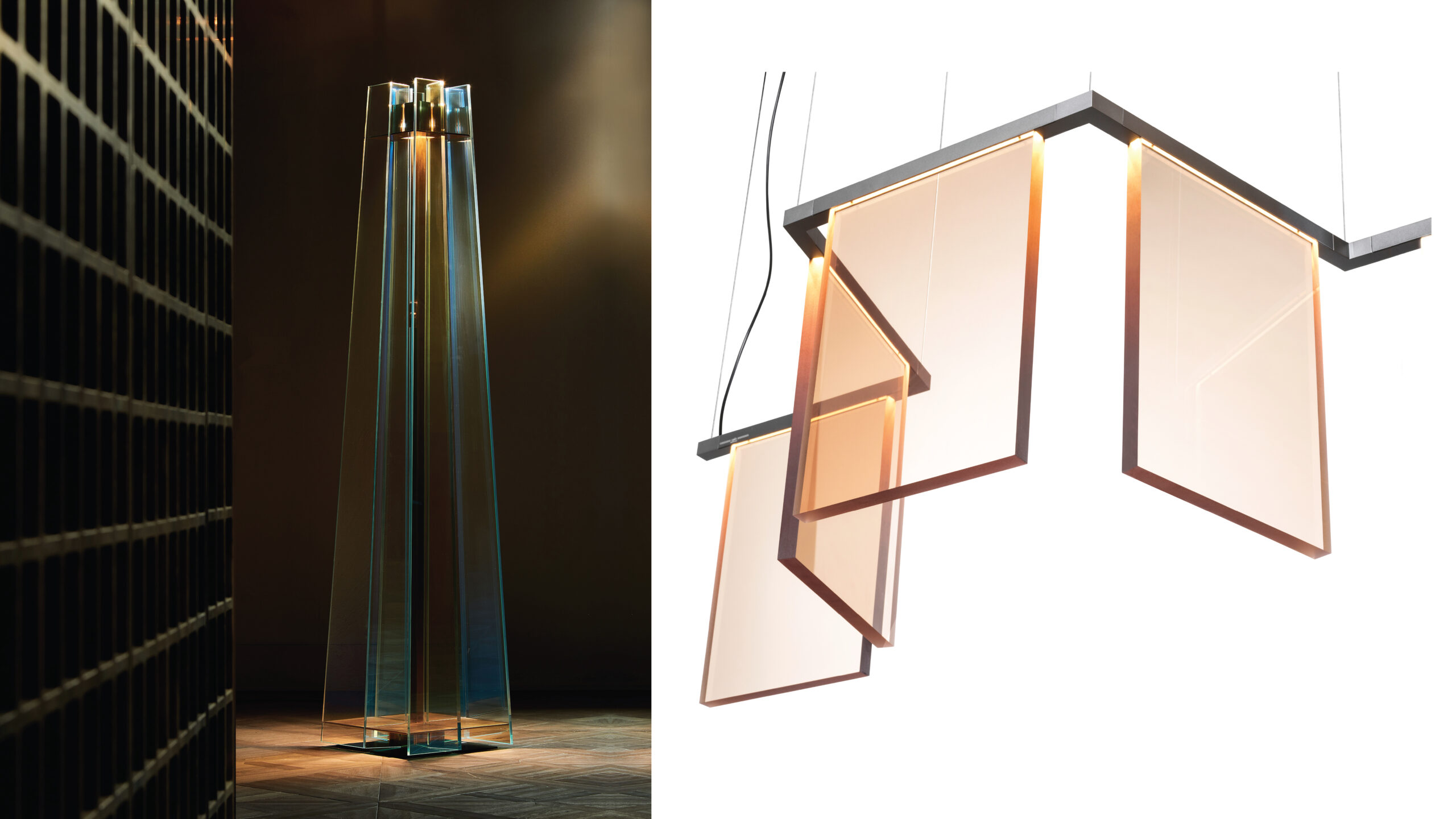
“I’m not a technical lighting designer,” Grawunder says. “I use light like a paint and a material. What matters is the experience.” Trained as an architect, she approaches lighting as both a spatial and emotional force. “The primary directive is to light what has to be lit,” she explains, “and then you can be sensorial and sculptural.” For Grawunder, quality of light is as critical as form—something she feels viscerally. “I see it and I feel it,” she says. “People might not realize it, but when a restaurant is well lit, you feel a certain way.”
That sensitivity is evident in Grawunder’s recent collaborations with Italian furnishings companies Henge and Ghidini 1961—brands known for monumental sofas and tables that are now veering into artful lighting. “They came to me because they wanted lighting with the same aesthetic heft,” she notes. For Henge, Stalagmite is a production floor lamp that reads as an art object: a pyramidal volume composed of flat sheets of dichroic glass held in brass framing. Warm light activates the glass, which reflects iridescently, shifting with the viewer’s position. “It’s easier in building installations,” Grawunder says, “but with a lamp it’s trickier—so I use materials like dichroic glass to do the work.”
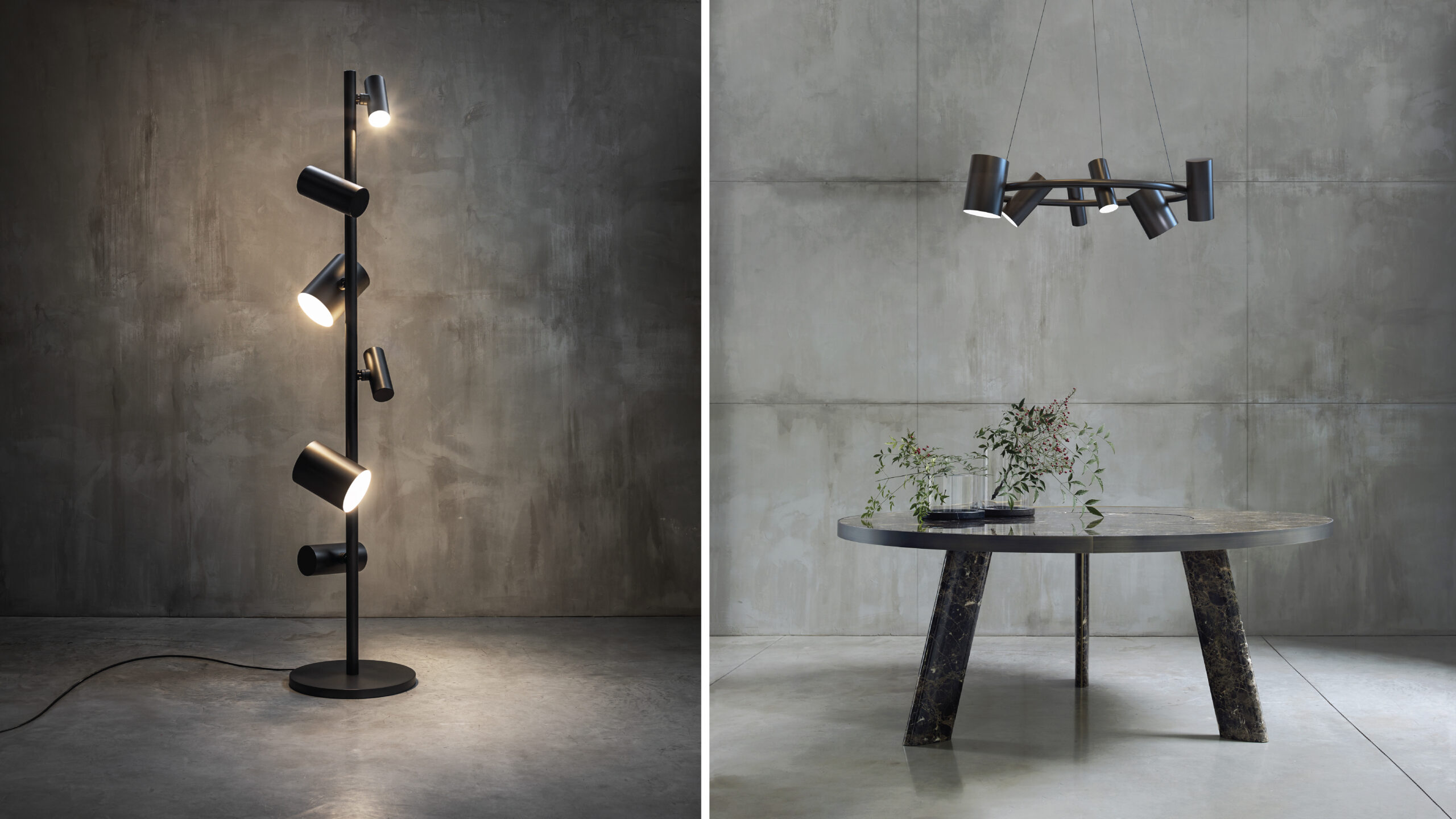
For Ghidini 1961, her Can Can series reinterprets 1950s track lighting as vertical, high-performance LED spotlights that can be adjusted and customized. Some configurations form linear and circular tracks, transforming utilitarian typologies into exaggerated chandeliers. “Anyone can do minimal,” Grawunder says. “If all you want is light on the table, shine a bulb. But I want object presence.” Dash, introduced in 2025, pushes light through cast acrylic in a zigzag pattern—“a lettering dash, a broken line”—made possible only through LED technology.
Across her work, light is never hidden. It passes through acrylic, sheet glass, and exposed hardware, asserting itself as both function and form. “Light is a medium,” Grawunder says, “and I’m trying to create effects with the light itself.”
grawunder.com
Photos courtesy of Henge and Ghidini 1961