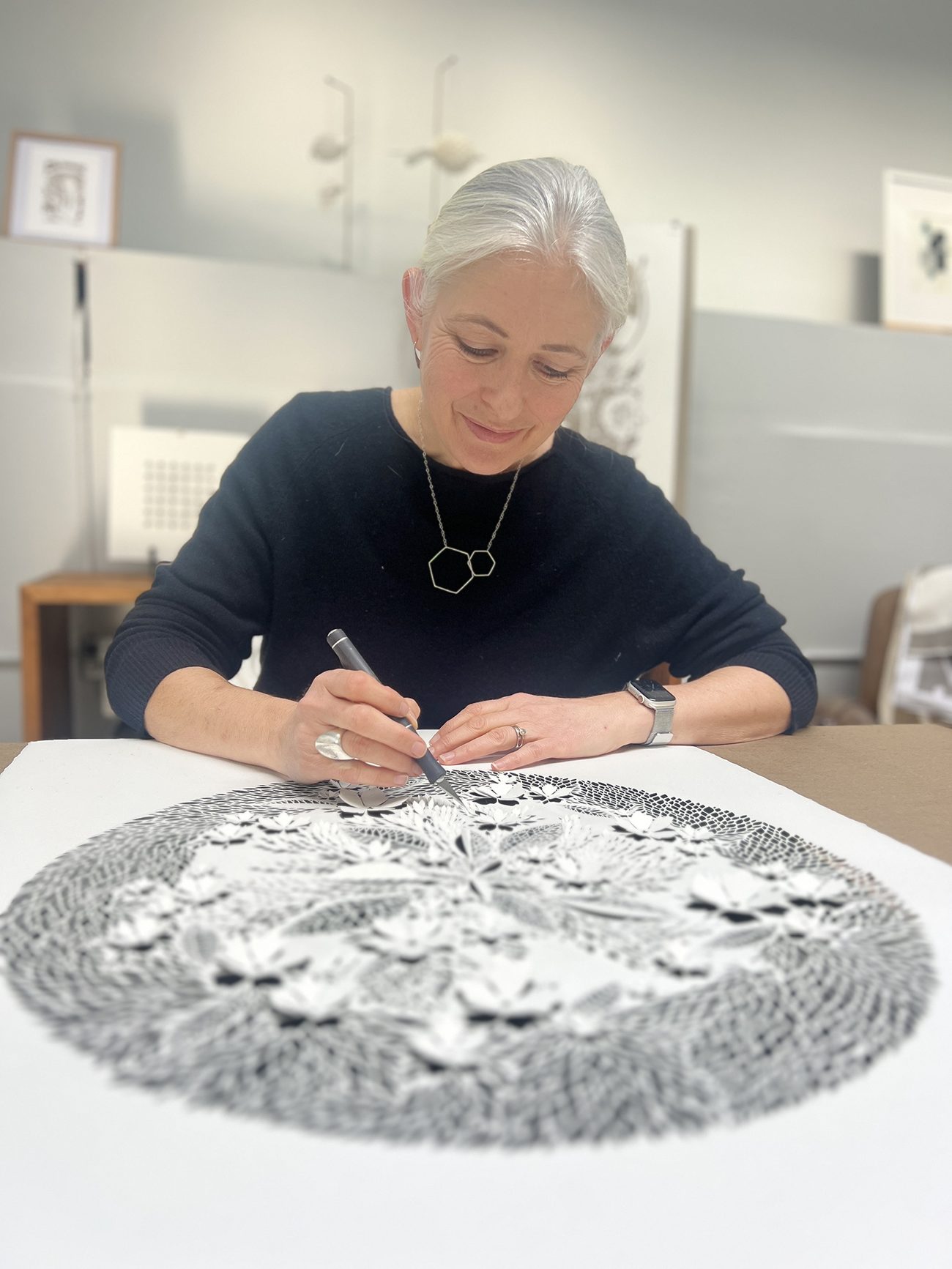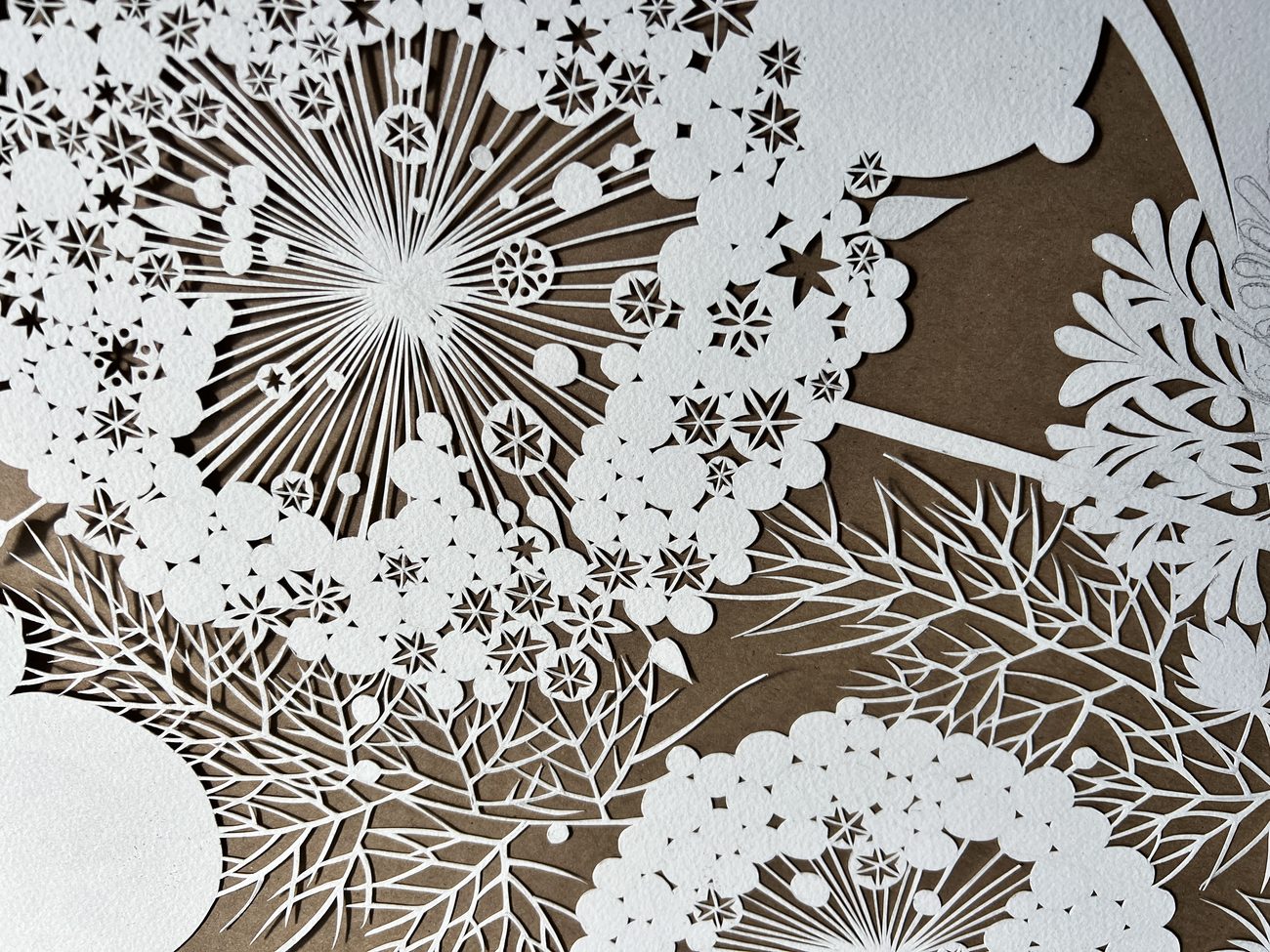
Her materials and tools are simple—paper, a pencil, and a sharp Xacto knife—but the intricate tracery of floriated patterns that artist Sara Burgess, 53, coaxes from linen-like sheets of white Japanese Kozo and Nepalese Lokta papers is a lacy marvel. What she calls “good connection points” hold the compositions together.
Though her work may evoke cutouts from ancient China, where paper was invented, Burgess’s high-key monochromatic pieces are unmistakably contemporary. They begin with a penciled pattern to guide her cutting, and the finished works are lightly mounted onto another sheet, allowing the negative and positive shapes to cast subtle shadows onto the backing, adding relief.
Art and craftsmanship are woven into Burgess’s upbringing. Both her parents were ceramicists in Manchester, England, where Burgess was born, and later, on their sheep farm in North Wales. When she was ten, they moved to a remote area of Vancouver Island in Canada, where they built another studio kiln by hand. Along the way, Burgess’s mother, a back-to-the-land advocate and expert seamstress, taught her to sew and embroider—skills that influenced some of the motifs Burgess now incorporates into her cutouts. They are the fiddlehead ferns, Queen Anne’s lace, nettles, brambles, and flowers of her rural childhood.
It wasn’t until she arrived in San Francisco to pursue a master’s in illustration at the Academy of Art University that she could fully explore her artistic roots. After college, she interned at Hallmark Cards in Missouri and later returned to the Bay Area as a ceramic tableware designer for Pottery Barn before moving to a hilltop home high above Mill Valley in 2011. There, she set up a vintage press for linocut printmaking, another of her passions. The cut paper process began by accident when she realized the sketchbooks of drawings for linocuts piling up had many unused pages. “I started cutting patterns directly into the pages of the books,” she says. “I liked the positive and negative shapes, and soon I pulled out pages for cutouts.”
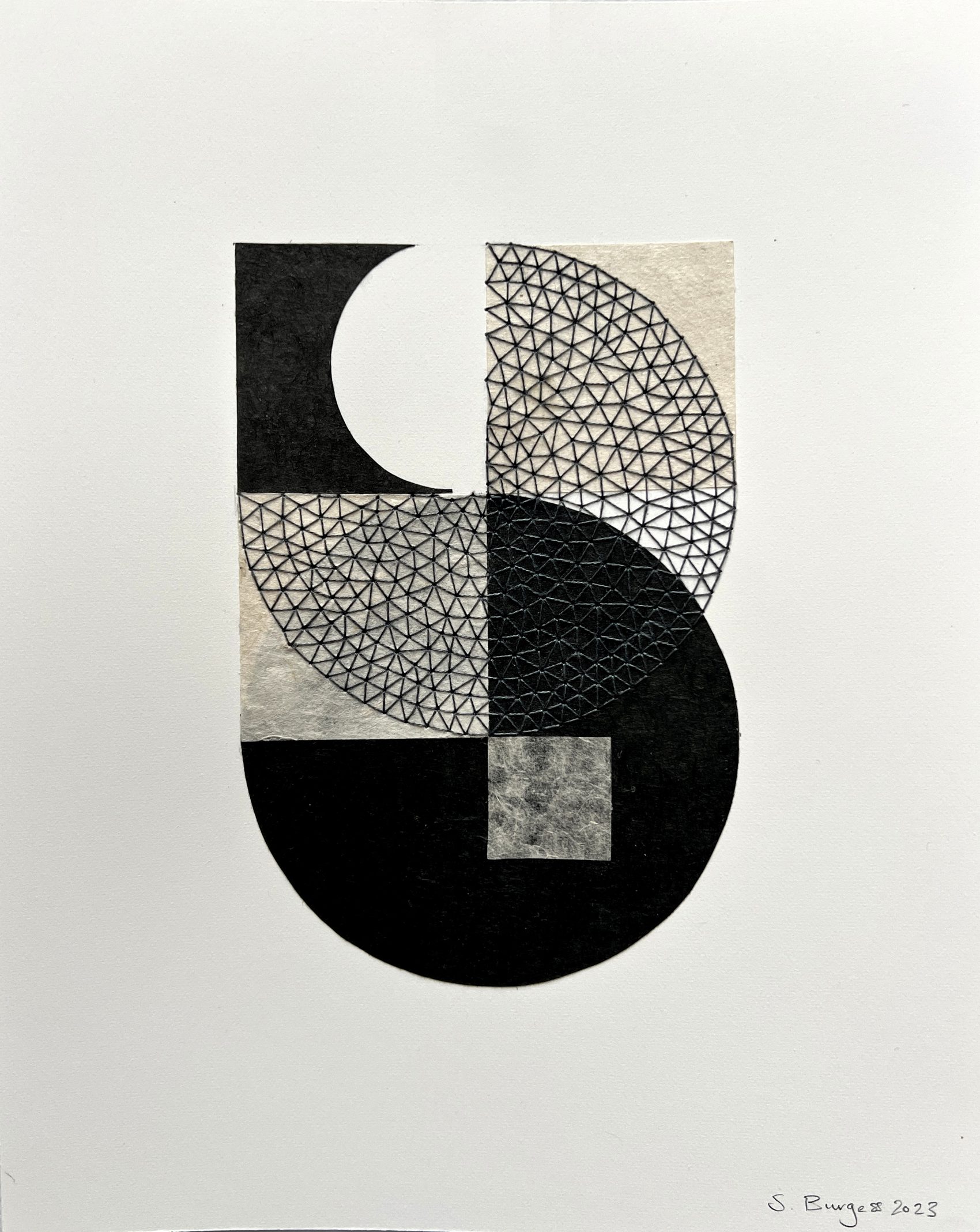
Recently, in a small studio in Sausalito, she has been experimenting with paper shapes hand-stitched together to form abstract, flower- or plant-inspired collages. “I perforate the paper and then stitch it,” Burgess explains. The dark-thread stitching forms lacy patterns. “I enjoy the outcome and the variation,” she adds. “The change of pace helps to rest the body,” Burgess says, reminding us that her delicate cutouts, are very hard work.
saraburgessstudio.com
View flipbook ↗